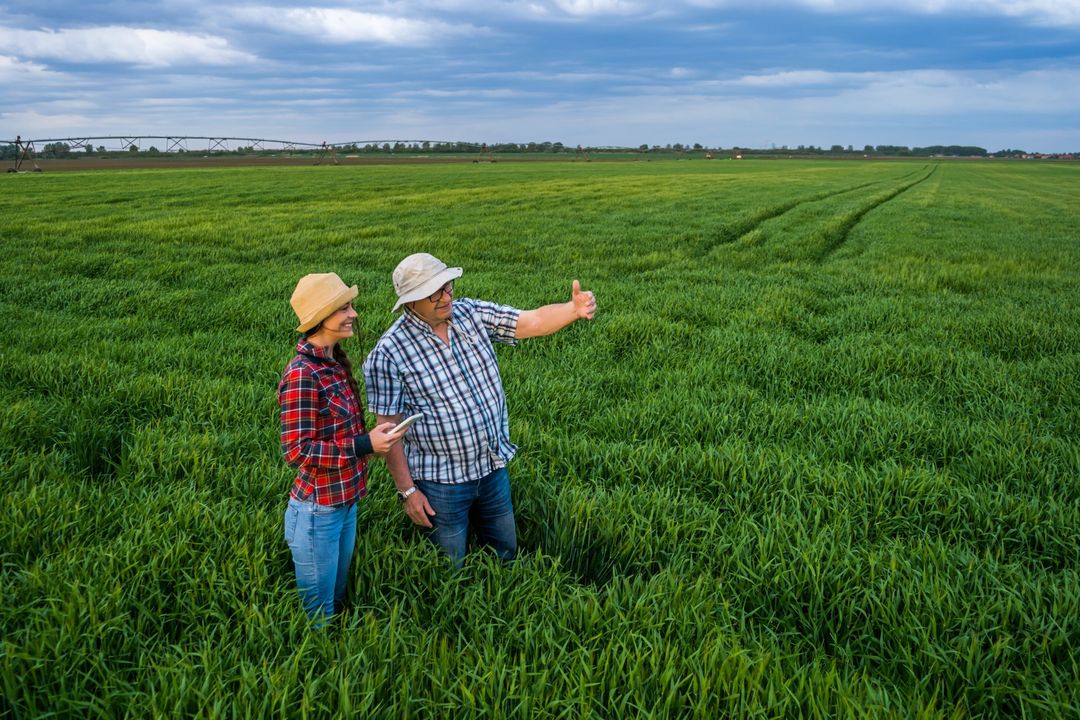
A farming family of three talking in a crop field at sunset

When the family can't talk
about the farm,
the farm can't
move forward.

Family business therapy for farming families facing
succession, conflict, and broken trust.

Who it's for

Farming and rural business families

How it runs

Individual sessions first, then key pairs, then the whole family

Where

In person or online, anywhere in Australia

First step

A confidential 30-minute conversation

The farm is the business, the home, and the family history.

You can't walk away from a farm disagreement. The person you argued with in the paddock is across the kitchen table that night, on land your parents and grandparents worked before you.

A farm usually can't be split without breaking it. So every question about who stays, who leaves, and who inherits carries decades of work, sacrifice, and things never said.

That's why farm succession stalls and conflict lingers. And it's why we bring family business therapy to farming families.

Therapy Designed for How Farming Families Actually Work

Grandparents walking behind the younger generation of their farming family across a cattle paddock

Parents and Successors

What we often see

The older generation still holds the land and the final say, while the next generation carries more of the work. The handover keeps being discussed and keeps not happening, and resentment builds on both sides.

How we help

We bring the pattern between you into view and work with the emotion beneath it, including the fear of letting go and the fear of waiting forever, so you can plan the handover together.

Four members of a farming family walking across a field at sunset

Siblings and Fairness

What we often see

The sibling who stayed feels owed for years of work, and the siblings who left want a fair share. Fair and equal get confused, and old rivalries return at every family gathering.

How we help

We name what each of you believes you're owed and why, repair the hurt in the room, and help you talk about fairness as one family, not as opponents.

Three generations of a rural family talking around an outdoor table

The Wider Family

What we often see

Partners marry into the farm and the third generation starts to have a say. Quiet alliances form, some members withdraw, and decisions get made at the kitchen table by whoever is there.

How we help

We surface the hidden alliances and the beliefs beneath them, and practise clear requests and quick repairs, so agreements hold across the generations.

Not sure where your family fits? That's common, and it's what the first conversation is for. Together we'll work out who should be in the room and where to begin.

What Can Change for Your Family

Talk About the Land Without It Turning Personal

Raise who stays, who leaves, and who inherits, and still share the kitchen table that night.

See the Pattern Behind the Arguments

See the cycle your family keeps repeating, so a disagreement about a paddock stops becoming an argument about the past.

Pass On the Farm and Keep the Family

Plan the handover so the farm stays whole and the relationships that built it stay strong.

How We Work With Your Family

Every family engagement follows the same five stages, in a deliberate order, so that by the time your whole family meets, everyone has already done their own work.

  1. 1

    Confidential 30-Minute Conversation

    A confidential video or phone conversation. We share our approach, and together we decide whether everpath is the right fit for your family.

  2. 2

    Written Agreement

    Every member receives the same agreement. It sets out confidentiality, how sessions run, and what to expect, so everyone starts on equal terms.

  3. 3

    Individual Sessions

    Each of you first has two or three sessions alone. We help each of you recognise your own patterns, challenge them, and start building new behaviours aligned with your core values. You can then arrive at joint sessions ready to work differently.

  4. 4

    Key Pair Sessions

    Each key pair, such as siblings or a parent and successor, works on their relationship, moving from naming the pattern to practising a new one. On average this takes two to four sessions, and it can take more when the relationship is more complex.

  5. 5

    Family-Wide Sessions

    With the groundwork done, the whole family meets. Family members practise new ways of engaging, repairing, and working together. Each family-wide session runs from four to eight hours, across one or two days.

What the Research Shows

Psychotherapy is one of the most studied treatments in health care. Here is what decades of research show about how well it works for individuals, couples, and families.

Individual therapy

79%

The average person who has psychotherapy ends up better off than about 79% of people who don't. For the emotion-focused and experiential therapies we draw on, controlled studies put the figure at about 81%, with the strongest results for relationship difficulties.

Wampold, 2007; Elliott et al., 2021

Couple/key pair therapy

70%

In the largest review of emotionally focused couple therapy, covering 20 studies, about 70% of struggling couples were no longer in distress by the end of therapy.

Spengler et al., 2024

Family therapy

71%

Across 20 research reviews of couple and family therapy, the average family in therapy ended up better off than more than 71% of families who didn't have it, and the gains held 6 to 12 months later.

Shadish and Baldwin, 2003

The Change Lasts

In a review of 38 clinical trials of family-focused therapy for adults, the gains held steady at follow-up, in some studies for as long as five years. For your family, this isn't a temporary calm that fades within weeks. It's a lasting change in how you talk, decide, and repair as a family.

von Sydow et al., 2010; Pinquart et al., 2016

Sources

A-Tjak, J. G. L., Davis, M. L., Morina, N., Powers, M. B., Smits, J. A. J., & Emmelkamp, P. M. G. (2015). A meta-analysis of the efficacy of acceptance and commitment therapy for clinically relevant mental and physical health problems. Psychotherapy and Psychosomatics, 84(1), 30–36. https://doi.org/10.1159/000365764

Cuijpers, P., Donker, T., Weissman, M. M., Ravitz, P., & Cristea, I. A. (2016). Interpersonal psychotherapy for mental health problems: A comprehensive meta-analysis. American Journal of Psychiatry, 173(7), 680–687. https://doi.org/10.1176/appi.ajp.2015.15091141

Elliott, R., Watson, J. C., Timulak, L., & Sharbanee, J. (2021). Research on humanistic-experiential psychotherapies: Updated review. In M. Barkham, W. Lutz, & L. G. Castonguay (Eds.), Bergin and Garfield's Handbook of Psychotherapy and Behavior Change (7th ed., pp. 421–467). Wiley.

Pinquart, M., Oslejsek, B., & Teubert, D. (2016). Efficacy of systemic therapy on adults with mental disorders: A meta-analysis. Psychotherapy Research, 26(2), 241–257. https://doi.org/10.1080/10503307.2014.935830

Shadish, W. R., & Baldwin, S. A. (2003). Meta-analysis of MFT interventions. Journal of Marital and Family Therapy, 29(4), 547–570.

Spengler, P. M., Lee, N. A., Wiebe, S. A., & Wittenborn, A. K. (2024). A comprehensive meta-analysis on the efficacy of emotionally focused couple therapy. Couple and Family Psychology: Research and Practice, 13(2), 81–99. https://doi.org/10.1037/cfp0000233

von Sydow, K., Beher, S., Schweitzer, J., & Retzlaff, R. (2010). The efficacy of systemic therapy with adult patients: A meta-content analysis of 38 randomized controlled trials. Family Process, 49(4), 457–485. https://doi.org/10.1111/j.1545-5300.2010.01334.x

Wampold, B. E. (2007). Psychotherapy: The humanistic (and effective) treatment. American Psychologist, 62(8), 857–873. https://doi.org/10.1037/0003-066X.62.8.857

Every engagement starts with a confidential 30-minute conversation.

See how it works, from first call to family sessions

The Clinical Specialist Alongside Your Agribusiness Advisors

What psychotherapy adds to farm succession planning. Your accountant, lawyer, and agribusiness advisors focus on structures, tax, and the succession plan itself. Psychotherapy targets the emotional and relational dynamics between family members: the wounds and unspoken expectations that can stall a farm succession for years. That way, the plan and the family can move forward.

Psychotherapy works on patterns, not just decisions. One-off conversations can get a family through a single decision. Psychotherapy works with the recurring patterns, how people speak, withdraw, attack, or protect, so future decisions are made in a stable emotional climate.

An older farmer and a younger woman talking in a green crop field

Meet Tom Skotidas

As the family business psychotherapist at everpath, Tom works with business families across Australia, including farming families.

  • Masters-qualified Psychotherapist

  • Member of the Australian Counselling Association
  • Member of the Family Business Association
  • Founder and director of a family business since 2011
  • Regularly invited to speak at family business conferences and forums across Australia
Tom Skotidas

My Shout podcast

Hear Tom in Conversation

On the My Shout podcast, Tom talks about how the patterns we learn as children replay in the boardroom.

Also interviewed on

Your Questions About Therapy for Farming Families

Can family business therapy help if our farm succession has stalled?

Yes. Succession usually stalls because of what sits beneath the plan: unspoken expectations, old hurts, and worries about what happens next for each person. We work with those directly, so your family can talk about the handover and make decisions together.

How is this different from succession planning, mediation, or rural financial counselling?

Your accountant, lawyer, and agribusiness advisors work on structures, tax, and the succession plan. A mediator helps you settle a specific dispute, and a rural financial counsellor helps with financial pressure. We do something different. As a psychotherapy practice, we work on the emotional and relational patterns underneath the conflict, often patterns that formed long before anyone took over the farm. We don't give business, legal, or financial advice, and we often work alongside your advisors.

How do we know it's time to see a psychotherapist?

Some telltale signs: the same argument keeps coming back in different forms; family members avoid each other, or only talk about the work; decisions about roles, ownership, or succession keep stalling; one person carries the family's tension, or gets blamed for it; and good advice isn't changing how people treat each other. If any of these sound familiar, a confidential first conversation can help you work out whether it's time for a family business psychotherapist.

We live a long way from a capital city. Can we still work with you?

Yes. Individual and key pair sessions work well online by video, wherever you are in Australia. Whole-family sessions usually happen in person, at our rooms in capital cities, and we also travel to farming families in regional Australia.

Who needs to take part?

Not everyone, at least not at first. Change often begins with one or two members, and others join as the work builds. Siblings who live away from the farm can take part online, and partners can join in stages when the family agrees. Every participating member agrees in writing before each new stage begins.

Will you take sides?

No. We work for each member and for the family as a whole. We don't act for one person against another, and we don't carry messages between members.

Is it confidential, including from our advisors and our local community?

Yes. Everything you share with us is strictly confidential, and what you share in individual sessions is never shared with another family member, directly or indirectly. Nothing is shared with your advisors, your bank, or anyone else without your written consent, and sessions can be held online, so no one locally needs to know. We work to the ethical standards of the Australian Counselling Association, so the only exceptions are the standard legal and ethical ones: serious risk to your safety or someone else's, situations where the law requires a report, and a court order.

Can we work with you if some of us already see a psychologist or counsellor?

Yes, and it's common. Many of the families we work with have one or two members who already see their own psychologist or counsellor. That work usually centres on the individual. Ours centres on where family, business, and wealth relationships meet. The two sit comfortably side by side, and we work alongside your existing practitioners rather than in place of them.

What if we're not ready to talk about something?

You stay in control of what we cover. We explore sensitive personal topics only to the degree you're comfortable. We are also trained to work with trauma and deeper emotional concerns, and we pace the work so it stays supportive.

How long are sessions, and how often?

Individual sessions run from 60 to 105 minutes, and key pair sessions from 90 to 120 minutes. Whole-family sessions are planned around the size of the group and usually run 4 to 8 hours over one or two days. Sessions usually start weekly or fortnightly, and can become less frequent as communication improves.

How many sessions will we need?

As few as the work needs. We set clear goals with you at the start, then about once a month we review progress against them and agree the scope, format, and expected length of the work ahead. We aim for lasting change in a focused time frame, not an open-ended engagement.

How do fees work for family business therapy?

Work runs in rounds. Each round is quoted in writing before it begins, so you always know the scope and the cost, and you're never locked into a long program. Fees depend on the format (individual, key pair, or whole family) and the length of each session. We share our full fee schedule in your free 30-minute conversation, or you can request it at info@everpath.com.au.

Three generations of a family walking down a hillside together, seen from behind

Your farm carries your family's work and history.
Let's make sure it holds.

A 30-minute conversation about your farming family. You'll leave with an honest view of how we can help and a clearer sense of your options. No cost. Strictly confidential.

Book Your everpath Session

Close